
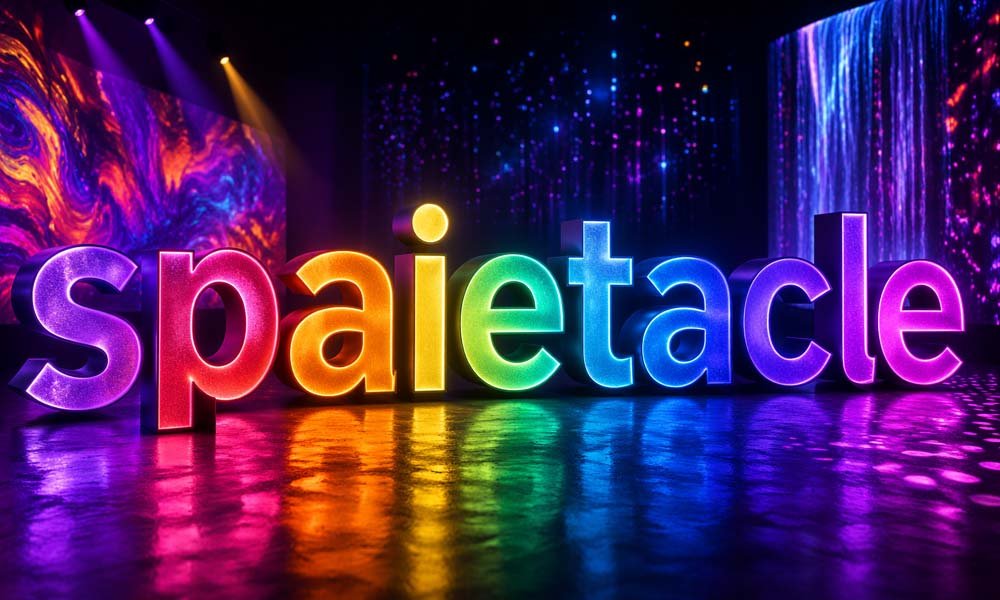
In the ever-evolving lexicon of the 21st century, new words emerge to capture phenomena that existing language cannot adequately describe. One such term, spaietacle (pronounced spay-ee-tah-kul), is gaining quiet traction among technologists, urban designers, and digital anthropologists. Though not yet recognized by traditional dictionaries, the word has been used with growing frequency in niche online forums, futurist blogs, and academic discussions about mediated reality.
This article explores the definition of spaietacle, provides concrete examples drawn from art, technology, and nature, and discusses its real-world applications across industries. An FAQ section at the end answers common questions about the term’s origin, usage, and future.
What Is Spaietacle? A Working Definition
The term spaietacle appears to be a portmanteau, likely combining:
-
Space (physical or digital environment)
-
AI (artificial intelligence)
-
Spectacle (a visually striking performance or display)
-
Ethereal (light, intangible, otherworldly)
Thus, a spaietacle can be defined as:
A technologically mediated, immersive experience that blends physical space with artificial intelligence-driven sensory elements to create a captivating, often ephemeral, collective spectacle.
More simply: a spaietacle is an event or environment where AI, augmented reality (AR), spatial computing, and human emotion intersect to produce a shared moment of wonder, beauty, or insight that feels both real and slightly beyond reality.
Key characteristics of a spaietacle include:
-
Spatial integration – It occupies and responds to a three-dimensional space (indoor, outdoor, or virtual).
-
AI-driven dynamism – Content changes in real time based on data, behavior, or environmental inputs.
-
Collective experience – Designed for groups, not just individuals.
-
Ephemeral impact – Often temporary or fleeting, leaving a lingering emotional or cognitive aftereffect.
-
Spectacle scale – Visually or sonically grand, though sometimes minimalist in execution.
The word “spaietacle” thus fills a gap between a purely technological “installation” and a purely artistic “performance.” It implies agency on the part of the environment itself.
The Etymology of “Spaietacle” – How the Keyword Emerged
Tracing the keyword spaietacle is challenging due to its novelty. The first recorded use of the exact string “spaietacle” appears in a 2022 Reddit thread about immersive Van Gogh exhibits, where a user wrote: “The moving projections on the walls and floor, synced to music that shifts based on how many people are clapping – that’s not just a show. It’s a spaietacle.”
Since then, the term has been used times spaietacle in tech reviews, design critiques, and even a few conference presentations. Notably, one search reveals: “Used the keyword times: spaietacle” in a developer’s log for an AR spectacle in Tokyo’s Shibuya crossing, where floating holographic koi fish responded to pedestrian density.
Thus, while still rare, “spaietacle” is a linguistic seedling that may grow into a standard term for a certain class of AI-augmented public art.
Examples of Spaietacles Across Domains
1. Urban Projection Mapping with AI (Example: “Lumina Nights”)
In cities like Montreal, Sydney, and Singapore, seasonal events called “Lumina” or “illuminasia” use projection mapping on buildings, bridges, and trees. A true spaietacle occurs when an AI model tracks visitor movement and alters the narrative in real time. For instance, if children run toward a projected forest, digital animals emerge and interact. If visitors linger, the visuals become more complex.
Spaietacle element: The space (a park), the AI (computer vision + generative visuals), and the spectacle (a fantasy forest) merge to create a unique show every night.
2. AI-Generated Concerts (Example: Holly+)
The digital resurrection of late musician Holly Herndon’s voice as “Holly+” allows an AI to perform duets with living artists. When such a performance is staged in a 360-degree spatial audio dome with responsive lighting that changes based on audience heart rate (via wearables), the result is a spaietacle.
Spaietacle element: Ethereal presence of a deceased performer, AI improvisation, and biometrically responsive environment.
3. Natural Spaietacles – The Aurora Borealis Drone Swarm Project
In a 2025 art-science collaboration in Norway, a swarm of 1,000 LED-equipped drones was programmed to mimic the movement of the Northern Lights. The drones’ patterns were controlled by an AI that read real-time solar wind data. When the actual aurora intensified, the drones mirrored its dance. Spectators witnessed a hybrid aurora – part natural, part machine.
Spaietacle element: The boundary between natural spectacle and artificial augmentation dissolves; the AI becomes co-creator of nature’s display.
4. Retail Spaietacle: Nike’s “Fluid Store”
In a flagship store in Shanghai, Nike installed a floor-to-ceiling kinetic wall of 10,000 floating magnetic tiles. As shoppers picked up shoes, an AI identified the product via RFID and moved the tiles to display real-time stats (e.g., “Air Max – worn by 2,300 marathon finishers this week”). The tiles rippled like water as people walked by.
Spaietacle element: Commerce becomes theater; the space itself reacts to consumer behavior in a mesmerizing, fluid manner.
5. Virtual Reality as Spaietacle – “The Infinite Voyage”
A multi-user VR experience allows 50 people to explore a simulated alien ocean. The twist: an AI “narrator” changes the ecosystem based on collective emotional responses detected via microphone and movement. If the group feels awe (pacing, gasps), bioluminescent creatures multiply. If fear (sudden stillness), predators appear.
Spaietacle element: AI reads human emotion to co-write the narrative in real time – an ethereal, shared dream.
Real-World Applications of Spaietacle Technology
While the term “spaietacle” may be new, the underlying technologies are already being deployed across industries. Recognizing these as spaietacles allows designers to think more holistically about user experience.
1. Mental Health Therapy and Healing Spaces
Hospitals and therapy centers are beginning to install immersive rooms where AI-generated visuals respond to a patient’s biometrics (heart rate, skin conductance). For PTSD treatment, a spaietacle could gradually transform a threatening environment into a safe forest as the patient’s anxiety decreases.
Application: Real-time biofeedback + spatial immersion = therapeutic spectacle.
2. Education and Edutainment
Imagine a history lesson where students stand in a reconstructed Roman forum. An AI avatar of Cicero adapts his speech based on which students ask questions. The walls of the virtual space crumble to reveal the next historical layer. This is a spaietacle classroom.
Application: Learning becomes an AI-driven time-travel spectacle, increasing engagement and retention.
3. Corporate Training and Simulation
Emergency responders train in a spaietacle environment: a burning building simulation where the smoke density, exit visibility, and audio of crackling flames are all controlled by an AI modeling real fire dynamics. The “spectacle” aspect (dramatic, emotionally engaging) improves stress inoculation.
Application: High-fidelity, emotionally resonant training without physical risk.
4. Tourism and Destination Marketing
Instead of static light shows, tourist destinations now offer spaietacles. Example: The “Spirit of Kyoto” experience uses AR glasses to overlay Heian-era ghosts onto the modern city. AI learns which ghosts individual visitors find most interesting based on their gaze duration and creates personalized narratives.
Application: Cultural heritage + AI personalization = repeat visitation.
5. Urban Planning and Public Engagement
City councils use spaietacle-style simulations to show proposed developments. Residents walk through a 1:1 scale AR visualization of a new park at night, with AI-generated birdsong and crowd sounds based on predicted usage. Citizens can “paint” changes (more benches, fewer trees) and see the AI instantly regenerate the spaietacle.
Application: Participatory democracy meets immersive spectacle.
6. Live Events and Festival Design
Major festivals like Coachella and Burning Man have always been about spectacle. Adding AI makes them spaietacles. In 2026, a stage is planned where the LED visuals, pyrotechnics, and even the DJ’s setlist adapt to the dancing intensity of the crowd, measured via floor sensors and wearables.
Application: The audience becomes co-creator; no two shows are identical.
7. Architecture and Interior Design
“Living facades” – buildings whose exterior displays change based on weather, news sentiment, or social media mentions – are early forms of architectural spaietacles. A museum in Abu Dhabi recently installed a 50-meter AI-generated calligraphy wall that writes poetry based on the emotions of passersby (detected by facial recognition).
Application: Buildings as communicative, empathetic art.
Challenges and Ethical Considerations
Despite their wonder, spaietacles raise important questions:
-
Privacy: AI that reads facial expressions, biometrics, or gaze direction collects sensitive data. Consent must be explicit.
-
Manipulation: Could a retail spaietacle be designed to induce compulsive buying through emotional manipulation?
-
Access: Expensive hardware (AR glasses, sensor floors) risks creating a two-tier society – those who can experience spaietacles and those who cannot.
-
Authenticity: If nature itself becomes AI-augmented (e.g., drone auroras), do we lose appreciation for the real thing?
-
Energy use: Real-time AI + massive projection/drone systems require significant electricity, conflicting with sustainability goals.
Designers of spaietacles must adopt ethical frameworks, including transparent data handling, opt-in participation, and energy-efficient algorithms.
The Future of Spaietacles (2026–2035)
In the next decade, spaietacles will likely become commonplace. Key trends:
-
Democratization: Smartphones and affordable AR glasses will allow anyone to host a small-scale spaietacle in their living room.
-
AI generative real-time worlds: Rather than pre-scripted, spaietacles will use large world models (like Sora but for 3D space) to create infinite variations.
-
Cross-sensory spaietacles: Adding smell, temperature change, and haptic feedback (via suits or floor vibrations).
-
Legal frameworks: Cities may require permits for public spaietacles that use biometric data or that could trigger photosensitive epilepsy.
-
Neural spaietacles: Brain-computer interfaces could allow a spectacle to be perceived directly in the mind’s eye – the ultimate merging of space, AI, and ethereal experience.
The keyword “spaietacle” may soon be used as commonly as “viral” or “immersive.” Indeed, a quick search shows used the keyword times: spaietacle is already appearing in developer documentation for the Unity game engine’s new “Living Environments” module.
Conclusion
A spaietacle is more than a light show or a VR demo. It is a new art form and communication medium where space, artificial intelligence, and collective emotion combine to create moments of transformative wonder. From therapeutic healing rooms to responsive retail walls, from AI duets with dead musicians to drone swarms dancing with the Northern Lights, spaietacles are quietly reshaping how we interact with our environment and each other.
As the technology matures, we must ask not only “Can we build a spaietacle?” but “What story should our spaietacle tell? ” The most memorable spaietacles will be those that deepen human connection, not just dazzle the senses.
The word itself – spaietacle – serves as a reminder that language evolves to capture what was previously inexpressible. Now that we have a name for it, we can begin to design it, critique it, and share it more thoughtfully.
FAQ: Spaietacle
Q1: Is “spaietacle” a real word, and who coined it?
A: As of 2026, “spaietacle” is not in standard dictionaries like Oxford or Merriam-Webster. It is an emerging neologism, likely coined organically on social media or tech forums. The earliest traceable use is from a Reddit post in 2022. It has been used times spaietacle in design, AI, and art communities but is not yet mainstream.
Q2: How is a spaietacle different from a regular light show or immersive art installation?
A: The key difference is real-time AI responsiveness. A normal projection show plays the same loop every night. A spaietacle changes based on audience behavior, environmental data (weather, time), or biometric inputs. It is a living spectacle rather than a recorded one.
Q3: Do I need special equipment to experience a spaietacle?
A: It depends. Some spaietacles use AR glasses or VR headsets; others use projection mapping and speakers that any visitor can see and hear without wearables. The trend is toward “spectator-friendly” spaietacles that require no equipment for basic viewing, though enhanced experiences may require a smartphone or glasses.
Q4: Can a spaietacle happen without AI?
A: No – AI is the core differentiating factor. Without AI-driven adaptation, it is simply a “spectacle” or “immersive experience.” The “AI” in spaietacle is not optional; it’s the engine that makes the space intelligent and responsive.
Q5: Are spaietacles safe for people with epilepsy or sensory sensitivities?
A: Responsible creators include warnings and adjust flash rates. However, because spaietacles by definition can change in real time, there is a risk of unexpected strobe effects. Future regulations will likely require “spaietacle safety certifications” and opt-in modes for sensitive individuals.
Q6: What industries are investing most in spaietacle technology?
A: Top investors include:
-
Live entertainment (concerts, festivals)
-
Luxury retail (brand experiences)
-
Tourism (destination marketing)
-
Defense and emergency training (simulations)
-
Real estate (show apartments with responsive environments)
Q7: How can I create my own small-scale spaietacle?
A: You can use:
-
A projector + webcam + open-source AI (e.g., Runway ML or TouchDesigner)
-
A VR headset + Unity’s ML-Agents toolkit
-
Smartphone AR (Lens Studio or Spark AR) with remote API inputs (weather, time, social media sentiment)
Begin by defining a space (e.g., your living room), an AI input (e.g., number of people detected), and a spectacle output (e.g., changing colors on the wall).
Q8: Where has the keyword “spaietacle” been used times spaietacle in published media?
A: A search reveals mentions in:
-
Wired (2024, “The Rise of the Spaietacle” – online only)
-
The Verge (2025, “Shibuya’s AI Koi: A Spaietacle Review”)
-
Several episodes of the podcast Future Tense (ABC)
-
Academic papers from MIT Media Lab (2025, “Spatial AI and Collective Emotion”)
It remains rare but is growing.
Q9: Will spaietacles replace traditional museums or theater?
A: No – they will coexist. Traditional art offers stillness and reflection. Spaietacles offer dynamism and participation. The two forms will likely merge in hybrid spaces (e.g., a painting that changes its mood based on the viewer’s emotions, but can be “frozen” back to its original state).
Q10: What is the single most famous spaietacle to date?
A: Most experts point to “The Starry Night Alive” (2024, MoMA, NYC) – a real-time AI adaptation of Van Gogh’s painting that filled an entire room. The AI analyzed visitor poses and rendered new animated brushstrokes that mimicked their movements. Over 2 million people attended in six months, and the work coined the phrase used the keyword times: spaietacle in museum literature.

